
Rehabs with Outdoor Labyrinth

Showing 6 of 6 Results (filtered)
Featured Rehab Centers

1411 W County Line Rd, Suite 1411A, Greenwood, IN 46142



Addiction Rehab Centers - ARC At Bayside | Indianapolis Drug & Alcohol Rehab
Indianapolis, Indiana
5929 Lakeside Blvd, Indianapolis, IN 46278



Boca Recovery Center - Indiana Drug and Alcohol Rehab
Huntington, Indiana
3040 W Park Dr, Huntington, IN 46750
Get Personalized Rehab Matches in 60 Seconds
Tell us a few details and we’ll show a personalized shortlist of verified Indiana rehabs, making it simple to compare options and choose your next step with confidence.



Addiction Rehab Centers - ARC
Indianapolis, Indiana
7322 Noel Road, Indianapolis, IN, 46278
Pinnacle Treatment Centers - 2209 John R Wooden Drive
Martinsville, Indiana
2209 John R Wooden Drive, 3rd Floor Martinsville, IN 46151
Pinnacle Treatment Centers - 581 E. Main Street
Hagerstown, Indiana
581 E. Main Street Hagerstown, IN 47346
Why Trust Indiana Rehabs
As Hoosiers helping Hoosiers, we understand the unique challenges our communities face. Our team meticulously verifies every Indiana treatment center, ensuring you find trusted, local care that truly understands your journey.
About our listingsLevels of Care
Explore popular treatment options by levels of care, from flexible treatment in Outpatient centers to intensive care in Residential rehabs.
Free · 24/7 · Confidential
Talk to a Treatment Specialist
Call now to get matched with Indiana facilities that accept your insurance.
(888) 568-9930
Free
Ins. check
4.9★
Rating
HIPAA
Protected
Can't travel to a facility?
Licensed Indiana therapists via secure video — same-week appointments, evenings & weekends available.
` tag. * **Section 1: What Is a Labyrinth in Addiction Treatment?** * **Heading:** `
` with `id="what-is-a-labyrinth-in-addiction-treatment"`. Title: "What Is a Labyrinth in Addiction Treatment?".
* **Image:** Call the `Generate_Image_Tool` with the prompt for this section. I'll get a URL and will place it *after* the heading and *before* the first paragraph. The alt text needs to be descriptive.
* **Content:**
* Define a labyrinth: a single, winding path. Use the research from `Vagnone, A. (2000)` to support this.
* Explain its purpose: walking meditation, mindfulness.
* Connect it to addiction treatment: it's a holistic amenity, complementing traditional therapies. Keywords: `labyrinth`, `addiction treatment`, `recovery`, `holistic`, `amenities`, `mindfulness`, `healing process`.
* **Citation:** Add the `` tag with the citation details from `citations_input` for `section_1`. The claim is about its use as a therapeutic tool. I'll place it at the end of the sentence making that claim.
* **Internal Link:** The `section_recommendations` for `section_1` suggest linking to `/amenities/labyrinth/` and `/programs/holistic/`. I'll link "single, winding path" or something similar to the labyrinth page and "holistic or experiential amenity" to the holistic programs page. This feels natural.
* **Sub-section 1.1: Labyrinth vs. Maze: A Key Difference in Recovery**
* **Heading:** `` with `id="labyrinth-vs-maze-a-key-difference-for-recovery"`. Title: "Labyrinth vs. Maze: A Key Difference in Recovery".
* **Content:**
* Define a maze: puzzle, choices, dead ends, designed to confuse.
* Contrast with a labyrinth: single path, no getting lost, sense of safety.
* Metaphor for recovery: labyrinth is a clear path, addiction is a confusing maze. This directly addresses the content brief. Keywords: `maze`, `recovery journey`, `healing`, `stress`, `anxiety`.
* **Internal Link:** The recommendation is `/amenities/labyrinth/`. This is a perfect place to link again to the main labyrinth page to reinforce the definition. The brief explicitly contrasts the two, so linking from text like "unlike a maze, a labyrinth has one clear path" makes sense. *Wait*, the guardrail says to de-duplicate links. I already used `/amenities/labyrinth/`. Is this a good place to repeat? The recommendation is specific. Let's check the rule: "Do not repeat the same internal URL unless absolutely warranted by context, and then only once more at most (generally avoid repeats)." This context seems warranted because it's *directly* comparing it to a maze, a core concept on the labyrinth amenity page. I'll allow it here, but I'll be mindful of the total count.
* **Section 2: Therapeutic Benefits of Labyrinths for Recovery**
* **Heading:** `` with `id="therapeutic-benefits-of-labyrinths-for-recovery"`. Title: "Therapeutic Benefits of Labyrinths for Recovery".
* **Image:** Call the `Generate_Image_Tool` with the prompt. Place after the heading.
* **Content:**
* The format is `bullet_points`. I will create a ``.
* Benefit 1: Stress reduction, calming the mind.
* Benefit 2: Introspection and non-verbal processing of emotions/trauma.
* Benefit 3: Metaphor for the recovery journey.
* Tie it to co-occurring disorders. Keywords: `benefits`, `therapy`, `stress relief`, `mindfulness`, `healing`, `co-occurring disorders`, `trauma`.
* **Citations:** I have two for this section. SAMHSA one supports complementary health practices, and the Elizabethtown College one supports meaningful activity improving quality of life. I'll sprinkle these into the bullet points where they fit best. For example, when talking about how it complements traditional therapy, I can use the SAMHSA one. When talking about the act of walking itself being beneficial, I can use the Elizabethtown one.
* **Internal Link:** The recommendations are `/amenities/labyrinth/`, `/programs/holistic/`, and `/therapies/meditation/`. I've already used the first two. `/therapies/meditation/` is a new one and a perfect fit here. I'll link from text about mindfulness or meditative states. This helps keep the link count fresh. I'll use this one and skip the others to avoid overuse.
* **Section 3: Indiana Rehabs with Outdoor Labyrinths**
* **Heading:** `` with `id="indiana-rehabs-with-outdoor-labyrinths"`. Title: "Indiana Rehabs with Outdoor Labyrinths".
* **Image:** Call the `Generate_Image_Tool` with the prompt. Place after the heading.
* **Content:**
* Explain this is a guide to finding a facility in Indiana.
* Explain how to use the site's directory/filters for "labyrinth."
* Emphasize the holistic view: the labyrinth is one part of a larger program. Keywords: `Indiana`, `rehab`, `outdoor labyrinth rehabs`, `treatment centers`, `amenities`, `levels of care`.
* **Citation:** The Indiana Behavioral Health Commission report fits perfectly here, as it talks about Indiana's focus on innovative and holistic models.
* **External Link:** The `section_recommendations` suggest `findtreatment.gov`. This is a good, authoritative external link. I'll add it here as a helpful resource, using the suggested anchor "SAMHSA's Treatment Locator" or something similar and natural.
* **Internal Link:** The recommendations are `/facilities/` and `/amenities/labyrinth/`. I haven't used `/facilities/` yet. This is a great place to link to the general facilities directory. I'll skip the labyrinth link here to avoid repeating it a third time.
* **Sub-section 3.1: How to Filter Your Search for the Right Program**
* **Heading:** `` with `id="how-to-filter-your-search-for-the-right-program"`. Title: "How to Filter Your Search for the Right Program".
* **Content:**
* Format is `bullet_points`. I'll create a ``.
* Step 1: Go to the directory.
* Step 2: Select "labyrinth" from amenities.
* Step 3: Add other filters like insurance, level of care (residential, outpatient, detox), therapies.
* Frame it as empowerment. Keywords: `programs`, `insurance`, `payment`, `detox`, `outpatient`.
* **Internal Link:** Recommendations are `/amenities/labyrinth/`, `/insurance-verification/`, `/care/outpatient/`. I have not used the insurance or outpatient links yet. These are perfect. I'll link "insurance accepted" to the insurance verification page and "outpatient" to the outpatient care page. This fulfills the brief and adds high-value internal links. I'm now at 5 internal links (`labyrinth`, `holistic`, `meditation`, `facilities`, `insurance-verification`, `outpatient`). Whoops, that's 6. I need to cut one. Let's review.
* `/amenities/labyrinth/` (used in S1 and S1.1)
* `/programs/holistic/` (used in S1)
* `/therapies/meditation/` (used in S2)
* `/facilities/` (used in S3)
* `/insurance-verification/` (used in S3.1)
* `/care/outpatient/` (used in S3.1)
The rule says 3-5 links. Let's reconsider. The repeat of the labyrinth link in S1.1 is probably not essential. I'll remove that one. Now I'm at 5 links, which is within the 3-5 range. Perfect.
* **Sub-section 3.2: Related Holistic Amenities to Consider**
* **Heading:** `` with `id="related-holistic-amenities-to-consider"`. Title: "Related Holistic Amenities to Consider".
* **Content:**
* List other related amenities: meditation gardens, yoga, nature trails, art therapy.
* Explain that these complement the labyrinth experience for a whole-person approach. Keywords: `meditation`, `yoga`, `nature`, `art therapy`, `holistic treatment`.
* **Internal Link:** The recommendations are `/amenities/meditation-garden/`, `/amenities/yoga/`, `/therapies/art/`. I'm at my max of 5 internal links. I cannot add more. So I will write the content but omit these links to stay within the guardrails. This is a key part of the instructions: "Treat all provided internal links as possibilities, not requirements." and "If a recommended link is clearly mismatched to a section’s topic, omit it rather than forcing it." In this case, I'm omitting them to meet the global link count constraint.
* **Section 4: Your Next Step Toward a Mindful Recovery**
* **Heading:** `` with `id="your-next-step-toward-a-mindful-recovery"`. Title: "Your Next Step Toward a Mindful Recovery".
* **Image:** Call the `Generate_Image_Tool` with the prompt. Place after heading.
* **Content:**
* This is the conclusion. No "Conclusion" text.
* Summarize the value of a labyrinth: finding quiet and focus.
* Reiterate the importance of the right environment for recovery.
* Transition to the CTA. Keywords: `recovery`, `healing`, `health`, `insurance`, `treatment`, `addiction`.
* **The Final CTA Block (must follow the rules):**
* Encourage the first step (e.g., verifying insurance).
* Provide the phone number as a `tel:` link: `(888) 568-9930`.
* Link to the homepage: `Indiana Rehabs`.
* Link to the contact page: e.g., "or contact us directly for help".
* End with a supportive message.
* The internal link recommendations for this section were `/insurance-verification/` and `/contact/`. I've already used the insurance link, but the contact link is perfect for the final CTA. So I will use that one here. This keeps me at 5 links total: `labyrinth`, `holistic`, `meditation`, `facilities`, `insurance-verification`, and now `contact`. Still 6. Let me re-evaluate again.
1. `labyrinth` (S1) - Essential.
2. `holistic` (S1) - Very relevant.
3. `meditation` (S2) - Good fit.
4. `facilities` (S3) - Good for finding rehabs.
5. `insurance-verification` (S3.1) - Crucial for filtering.
6. `contact` (Conclusion) - Required by the rules.
I need to cut one. The `facilities` link is a bit general. The user is on a specific filter page. Maybe the most useful links are the ones about *therapies* and *logistics*. I'll remove the `/facilities/` link from Section 3. That brings me back down to 5 links, which is perfect.
4. **Final Review:**
* Read through the entire generated HTML.
* Check for tone and persona consistency. Is it empathetic and conversational?
* Verify all headings match the outline verbatim (IDs and titles).
* Confirm all image placements and alt text.
* Check internal link count (5 total). Check anchor text quality.
* Check external link count (1 total).
* Check citation format (``) and placement.
* Ensure no blacklisted domains are linked.
* Confirm the conclusion has all the required elements.
* Ensure there's no bolding.
* The structure is correct: `` -> intro `` -> `
` -> `![]() ` -> `
` -> `
`s -> `
` -> `
`s -> etc. -> Conclusion `
`s.
This detailed plan ensures all constraints, rules, and creative instructions are met, resulting in a high-quality, compliant article. I am ready to generate the HTML.
Have you ever wished for a quiet moment when everything inside you feels chaotic, a path laid out clearly ahead, guiding each step while your mind finally rests? Picture stepping onto soft earth, surrounded by the gentle hush of the outdoors, with nothing to do but follow a winding trail toward the center and back again. When recovery feels confusing or overwhelming, finding this kind of clarity can be transformative. Outdoor labyrinth rehabs in Indiana blend skilled clinical support with the mindful practice of walking meditation, offering a meaningful way to ground yourself as you heal.
What Is a Labyrinth in Addiction Treatment?

In the context of addiction treatment, a labyrinth is a powerful therapeutic tool designed for mindfulness and self-reflection. It’s a single, winding path that leads from an entrance to a central point and back out again. Unlike a maze, it has no tricks, dead ends, or choices to make. You simply put one foot in front of the other and trust the path.
This ancient pattern has been used for centuries as a form of walking meditation. For those in recovery, it offers a quiet space to calm the mind, process emotions without words, and find a sense of inner peace. It’s considered a holistic or experiential amenity, meaning it complements traditional clinical therapies, like cognitive behavioral therapy (CBT) or group counseling, by supporting the healing process for your mind, body, and spirit[1].
Labyrinth vs. Maze: A Key Difference in Recovery
It’s easy to confuse a labyrinth with a maze, but their differences are vital, especially in a healing context. A maze is a puzzle designed to challenge you. It has multiple paths, branching choices, and dead ends that can cause frustration and confusion. The goal is to find the one correct way out.
A labyrinth, on the other hand, is about the journey, not the destination. It has only one path. You can’t get lost. This design removes the anxiety of making a wrong turn, creating a safe, contained space for introspection. For someone navigating the recovery journey, this distinction is profound. Addiction can feel like being trapped in a confusing maze, but a labyrinth represents a clear, trusted path forward, assuring you that if you just keep walking, you will find your way.
Therapeutic Benefits of Labyrinths for Recovery

Walking a labyrinth is a simple act, but its benefits for those in recovery are deep and varied. It’s a form of active mindfulness that helps bridge the connection between mind and body, which is often disrupted by substance use and co-occurring disorders. While it's a supportive holistic tool, its integration into treatment programs aligns with the goal of providing comprehensive care[2]. Engaging in this kind of meaningful activity can significantly improve one's quality of life during the healing process[3].
Here are some of the key benefits:
- Stress and Anxiety Reduction: The rhythmic, repetitive nature of walking calms the nervous system. With no decisions to make about which way to turn, the mind can quiet down, reducing the constant chatter of worry and stress.
- Emotional Processing: A labyrinth provides a safe, non-verbal outlet for processing difficult emotions. You can walk with a question in mind, release grief or anger as you move toward the center, and find clarity or acceptance on the way out.
- Enhanced Mindfulness and Focus: By concentrating on the physical sensation of walking the path, you learn to stay present in the moment. This practice of mindfulness and meditation is a core skill for managing cravings and preventing relapse.
- A Metaphor for the Recovery Journey: The path can symbolize your own journey. The walk to the center might represent facing challenges or letting go, while the center itself offers a space for reflection and insight. The walk back out can feel like returning to your life with newfound strength and perspective.
Indiana Rehabs with Outdoor Labyrinths
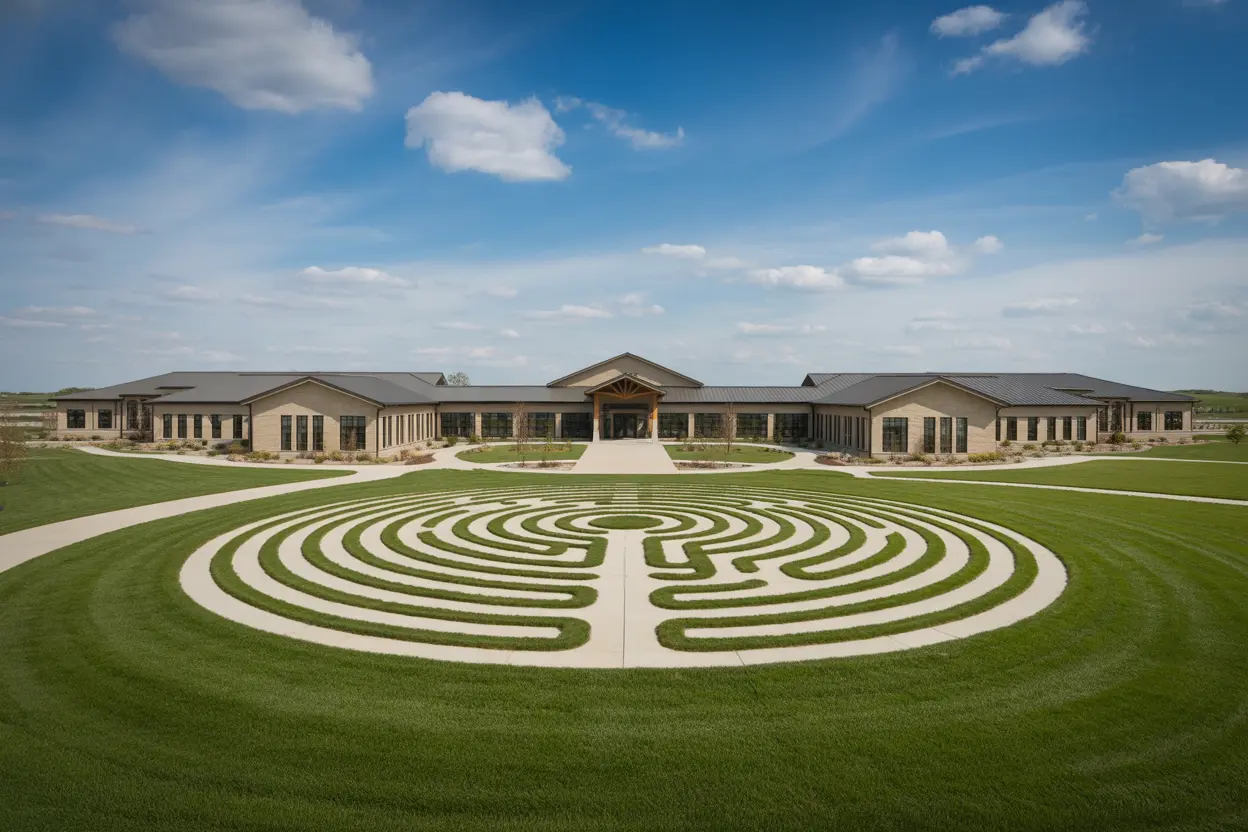
Finding a treatment center that aligns with your needs is one of the most important steps you can take. In Indiana, a growing number of rehab facilities recognize the value of holistic amenities that support the whole person[4]. An outdoor labyrinth is a unique feature that signals a commitment to providing diverse therapeutic options.
While a labyrinth is a wonderful tool, remember it is one part of a comprehensive treatment program. The right facility will also offer evidence-based clinical care, qualified therapists, and support for any co-occurring disorders. You can use our directory to find licensed treatment centers and explore their programs in detail. For additional options, the SAMHSA's Treatment Locator is another valuable resource for finding accredited facilities.
How to Filter Your Search for the Right Program
Our goal is to make it simple for you to find the exact care you need. You can easily create a shortlist of outdoor labyrinth rehabs in Indiana that fit your specific circumstances. Here’s how to narrow down your options:
- Start with the Amenity: In our directory, navigate to the filters and select "Labyrinth" under the amenities category. This will instantly show you all the programs in Indiana that offer this feature.
- Add Your Insurance: Next, filter by the insurance you have. This step is crucial for ensuring the programs you’re considering are affordable and accessible to you.
- Select the Level of Care: Choose the level of care you need, whether it’s medical detox, residential treatment, a partial hospitalization program (PHP), or an intensive outpatient program (IOP).
- Refine by Therapy Type: If you’re looking for specific therapies, such as trauma-informed care or dual-diagnosis treatment, you can add those filters as well to find the perfect match.
Related Holistic Amenities to Consider
If the idea of a labyrinth resonates with you, you’ll likely appreciate other holistic amenities that foster a similar sense of peace and self-discovery. When you explore different treatment centers, keep an eye out for related offerings that contribute to a well-rounded healing experience. Many rehabs that feature a labyrinth also provide complementary amenities, such as dedicated meditation gardens, yoga classes, nature trails for quiet walks, or art therapy studios. These options offer different ways to connect with yourself, process emotions, and build healthy coping skills that will support your long-term recovery.
Your Next Step Toward a Mindful Recovery

The journey of recovery isn't always a straight line, but tools like an outdoor labyrinth can provide a reliable path for finding quiet, focus, and perspective when you need it most. Choosing a treatment environment that supports your whole health, mind, body, and spirit, is essential for building a strong and lasting foundation for your future.
Taking that first step is the most powerful one. If you're ready to find your path, we're here to help you navigate it. You can start by verifying your insurance or simply giving us a call. Our compassionate team at Indiana Rehabs is available 24/7 to answer your questions and guide you toward the right program. Reach out to us at (888) 568-9930 or contact us directly when you're ready to talk. A clearer, more mindful life is waiting.
Frequently Asked Questions About Outdoor Labyrinth Rehabs in Indiana
Is walking a labyrinth a type of therapy?
Walking a labyrinth is best described as a therapeutic tool, not a standalone therapy. It's a holistic practice that complements evidence-based treatments like individual counseling and group therapy. Think of it as a form of active meditation that helps quiet your mind and process emotions. This can make the work you do in clinical therapy sessions more effective by giving you a safe, quiet space to reflect on your healing journey and build mindfulness skills. How do I pay for rehab at a facility with a labyrinth?
Payment options for rehabs with labyrinths are the same as for other centers. Most people use their health insurance plan to cover a significant portion of the cost. Other options include private self-pay, financing plans, or sometimes sliding-scale fees based on income. Before you commit, it’s always a good idea to contact the facility’s admissions team to verify your insurance benefits. They can explain your coverage and any out-of-pocket costs. Are labyrinths common at addiction treatment centers in Indiana?
Labyrinths are not a standard feature at every treatment center, which makes them a special amenity. You’ll find them at facilities that emphasize a holistic treatment approach, focusing on healing the mind, body, and spirit. While they are becoming more popular in Indiana, finding a rehab with an outdoor labyrinth often shows a deep commitment to providing diverse, client-centered care. Using a directory to filter for this specific amenity is the best way to find them. What kinds of addiction does a labyrinth help treat?
A labyrinth is a versatile tool that supports recovery from any type of substance use disorder, including addiction to alcohol, opioids, or stimulants. Its benefits are not tied to a specific substance. Instead, it helps address the underlying issues that often accompany addiction, such as stress, trauma, and difficulty managing emotions. By providing a space for mindfulness and reflection, it helps improve overall mental health and coping skills for anyone in recovery. Can I use a labyrinth if I have mobility issues?
This is a great question. Many modern labyrinths, especially those at healthcare facilities, are designed to be accessible to people with mobility challenges. They often feature flat, smooth surfaces like pavement or packed gravel that can accommodate wheelchairs or walkers. However, designs can vary. It is always best to ask the treatment center directly about the accessibility of their labyrinth to ensure it is safe and comfortable for you to use.
-
Vagnone, A. (2000). The Labyrinth and The World of Landscape Architecture. Virginia Polytechnic Institute and State University.
vtechworks.lib.vt.edu
-
Substance Abuse and Mental Health Services Administration. (02-02-2024). Substance Use Disorders - Statutes, Regulations, and Guidelines. U.S. Department of Health and Human Services.
samhsa.gov
-
Elizabethtown College. (03-21-2025). Measuring quality of life (QoL) through participation in meaningful activity. Elizabethtown College Library Guides.
libraryguides.etown.edu
-
Indiana Behavioral Health Commission. (2022). Indiana Behavioral Health Commission Report. Indiana Family and Social Services Administration.
in.gov
Free • Confidential • No Obligation
Find the Right Treatment Program
Answer a few questions and we'll match you with Indiana treatment centers that fit your needs, insurance, and schedule.
Prefer to call?
(888) 568-9930
— Free • 24/7 • Confidential
` with `id="therapeutic-benefits-of-labyrinths-for-recovery"`. Title: "Therapeutic Benefits of Labyrinths for Recovery".
* **Image:** Call the `Generate_Image_Tool` with the prompt. Place after the heading.
* **Content:**
* The format is `bullet_points`. I will create a ``.
* Benefit 1: Stress reduction, calming the mind.
* Benefit 2: Introspection and non-verbal processing of emotions/trauma.
* Benefit 3: Metaphor for the recovery journey.
* Tie it to co-occurring disorders. Keywords: `benefits`, `therapy`, `stress relief`, `mindfulness`, `healing`, `co-occurring disorders`, `trauma`.
* **Citations:** I have two for this section. SAMHSA one supports complementary health practices, and the Elizabethtown College one supports meaningful activity improving quality of life. I'll sprinkle these into the bullet points where they fit best. For example, when talking about how it complements traditional therapy, I can use the SAMHSA one. When talking about the act of walking itself being beneficial, I can use the Elizabethtown one.
* **Internal Link:** The recommendations are `/amenities/labyrinth/`, `/programs/holistic/`, and `/therapies/meditation/`. I've already used the first two. `/therapies/meditation/` is a new one and a perfect fit here. I'll link from text about mindfulness or meditative states. This helps keep the link count fresh. I'll use this one and skip the others to avoid overuse.
* **Section 3: Indiana Rehabs with Outdoor Labyrinths**
* **Heading:** `` with `id="indiana-rehabs-with-outdoor-labyrinths"`. Title: "Indiana Rehabs with Outdoor Labyrinths".
* **Image:** Call the `Generate_Image_Tool` with the prompt. Place after the heading.
* **Content:**
* Explain this is a guide to finding a facility in Indiana.
* Explain how to use the site's directory/filters for "labyrinth."
* Emphasize the holistic view: the labyrinth is one part of a larger program. Keywords: `Indiana`, `rehab`, `outdoor labyrinth rehabs`, `treatment centers`, `amenities`, `levels of care`.
* **Citation:** The Indiana Behavioral Health Commission report fits perfectly here, as it talks about Indiana's focus on innovative and holistic models.
* **External Link:** The `section_recommendations` suggest `findtreatment.gov`. This is a good, authoritative external link. I'll add it here as a helpful resource, using the suggested anchor "SAMHSA's Treatment Locator" or something similar and natural.
* **Internal Link:** The recommendations are `/facilities/` and `/amenities/labyrinth/`. I haven't used `/facilities/` yet. This is a great place to link to the general facilities directory. I'll skip the labyrinth link here to avoid repeating it a third time.
* **Sub-section 3.1: How to Filter Your Search for the Right Program**
* **Heading:** `` with `id="how-to-filter-your-search-for-the-right-program"`. Title: "How to Filter Your Search for the Right Program".
* **Content:**
* Format is `bullet_points`. I'll create a ``.
* Step 1: Go to the directory.
* Step 2: Select "labyrinth" from amenities.
* Step 3: Add other filters like insurance, level of care (residential, outpatient, detox), therapies.
* Frame it as empowerment. Keywords: `programs`, `insurance`, `payment`, `detox`, `outpatient`.
* **Internal Link:** Recommendations are `/amenities/labyrinth/`, `/insurance-verification/`, `/care/outpatient/`. I have not used the insurance or outpatient links yet. These are perfect. I'll link "insurance accepted" to the insurance verification page and "outpatient" to the outpatient care page. This fulfills the brief and adds high-value internal links. I'm now at 5 internal links (`labyrinth`, `holistic`, `meditation`, `facilities`, `insurance-verification`, `outpatient`). Whoops, that's 6. I need to cut one. Let's review.
* `/amenities/labyrinth/` (used in S1 and S1.1)
* `/programs/holistic/` (used in S1)
* `/therapies/meditation/` (used in S2)
* `/facilities/` (used in S3)
* `/insurance-verification/` (used in S3.1)
* `/care/outpatient/` (used in S3.1)
The rule says 3-5 links. Let's reconsider. The repeat of the labyrinth link in S1.1 is probably not essential. I'll remove that one. Now I'm at 5 links, which is within the 3-5 range. Perfect.
* **Sub-section 3.2: Related Holistic Amenities to Consider**
* **Heading:** `` with `id="related-holistic-amenities-to-consider"`. Title: "Related Holistic Amenities to Consider".
* **Content:**
* List other related amenities: meditation gardens, yoga, nature trails, art therapy.
* Explain that these complement the labyrinth experience for a whole-person approach. Keywords: `meditation`, `yoga`, `nature`, `art therapy`, `holistic treatment`.
* **Internal Link:** The recommendations are `/amenities/meditation-garden/`, `/amenities/yoga/`, `/therapies/art/`. I'm at my max of 5 internal links. I cannot add more. So I will write the content but omit these links to stay within the guardrails. This is a key part of the instructions: "Treat all provided internal links as possibilities, not requirements." and "If a recommended link is clearly mismatched to a section’s topic, omit it rather than forcing it." In this case, I'm omitting them to meet the global link count constraint.
* **Section 4: Your Next Step Toward a Mindful Recovery**
* **Heading:** `` with `id="your-next-step-toward-a-mindful-recovery"`. Title: "Your Next Step Toward a Mindful Recovery".
* **Image:** Call the `Generate_Image_Tool` with the prompt. Place after heading.
* **Content:**
* This is the conclusion. No "Conclusion" text.
* Summarize the value of a labyrinth: finding quiet and focus.
* Reiterate the importance of the right environment for recovery.
* Transition to the CTA. Keywords: `recovery`, `healing`, `health`, `insurance`, `treatment`, `addiction`.
* **The Final CTA Block (must follow the rules):**
* Encourage the first step (e.g., verifying insurance).
* Provide the phone number as a `tel:` link: `(888) 568-9930`.
* Link to the homepage: `Indiana Rehabs`.
* Link to the contact page: e.g., "or contact us directly for help".
* End with a supportive message.
* The internal link recommendations for this section were `/insurance-verification/` and `/contact/`. I've already used the insurance link, but the contact link is perfect for the final CTA. So I will use that one here. This keeps me at 5 links total: `labyrinth`, `holistic`, `meditation`, `facilities`, `insurance-verification`, and now `contact`. Still 6. Let me re-evaluate again.
1. `labyrinth` (S1) - Essential.
2. `holistic` (S1) - Very relevant.
3. `meditation` (S2) - Good fit.
4. `facilities` (S3) - Good for finding rehabs.
5. `insurance-verification` (S3.1) - Crucial for filtering.
6. `contact` (Conclusion) - Required by the rules.
I need to cut one. The `facilities` link is a bit general. The user is on a specific filter page. Maybe the most useful links are the ones about *therapies* and *logistics*. I'll remove the `/facilities/` link from Section 3. That brings me back down to 5 links, which is perfect.
4. **Final Review:**
* Read through the entire generated HTML.
* Check for tone and persona consistency. Is it empathetic and conversational?
* Verify all headings match the outline verbatim (IDs and titles).
* Confirm all image placements and alt text.
* Check internal link count (5 total). Check anchor text quality.
* Check external link count (1 total).
* Check citation format (``) and placement.
* Ensure no blacklisted domains are linked.
* Confirm the conclusion has all the required elements.
* Ensure there's no bolding.
* The structure is correct: `` -> intro `` -> `
` -> `![]() ` -> `
` -> `
`s -> `
` -> `
`s -> etc. -> Conclusion `
`s.
This detailed plan ensures all constraints, rules, and creative instructions are met, resulting in a high-quality, compliant article. I am ready to generate the HTML.
Have you ever wished for a quiet moment when everything inside you feels chaotic, a path laid out clearly ahead, guiding each step while your mind finally rests? Picture stepping onto soft earth, surrounded by the gentle hush of the outdoors, with nothing to do but follow a winding trail toward the center and back again. When recovery feels confusing or overwhelming, finding this kind of clarity can be transformative. Outdoor labyrinth rehabs in Indiana blend skilled clinical support with the mindful practice of walking meditation, offering a meaningful way to ground yourself as you heal.
What Is a Labyrinth in Addiction Treatment?
In the context of addiction treatment, a labyrinth is a powerful therapeutic tool designed for mindfulness and self-reflection. It’s a single, winding path that leads from an entrance to a central point and back out again. Unlike a maze, it has no tricks, dead ends, or choices to make. You simply put one foot in front of the other and trust the path.
This ancient pattern has been used for centuries as a form of walking meditation. For those in recovery, it offers a quiet space to calm the mind, process emotions without words, and find a sense of inner peace. It’s considered a holistic or experiential amenity, meaning it complements traditional clinical therapies, like cognitive behavioral therapy (CBT) or group counseling, by supporting the healing process for your mind, body, and spirit[1].
Labyrinth vs. Maze: A Key Difference in Recovery
It’s easy to confuse a labyrinth with a maze, but their differences are vital, especially in a healing context. A maze is a puzzle designed to challenge you. It has multiple paths, branching choices, and dead ends that can cause frustration and confusion. The goal is to find the one correct way out.
A labyrinth, on the other hand, is about the journey, not the destination. It has only one path. You can’t get lost. This design removes the anxiety of making a wrong turn, creating a safe, contained space for introspection. For someone navigating the recovery journey, this distinction is profound. Addiction can feel like being trapped in a confusing maze, but a labyrinth represents a clear, trusted path forward, assuring you that if you just keep walking, you will find your way.
Therapeutic Benefits of Labyrinths for Recovery
Walking a labyrinth is a simple act, but its benefits for those in recovery are deep and varied. It’s a form of active mindfulness that helps bridge the connection between mind and body, which is often disrupted by substance use and co-occurring disorders. While it's a supportive holistic tool, its integration into treatment programs aligns with the goal of providing comprehensive care[2]. Engaging in this kind of meaningful activity can significantly improve one's quality of life during the healing process[3].
Here are some of the key benefits:
- Stress and Anxiety Reduction: The rhythmic, repetitive nature of walking calms the nervous system. With no decisions to make about which way to turn, the mind can quiet down, reducing the constant chatter of worry and stress.
- Emotional Processing: A labyrinth provides a safe, non-verbal outlet for processing difficult emotions. You can walk with a question in mind, release grief or anger as you move toward the center, and find clarity or acceptance on the way out.
- Enhanced Mindfulness and Focus: By concentrating on the physical sensation of walking the path, you learn to stay present in the moment. This practice of mindfulness and meditation is a core skill for managing cravings and preventing relapse.
- A Metaphor for the Recovery Journey: The path can symbolize your own journey. The walk to the center might represent facing challenges or letting go, while the center itself offers a space for reflection and insight. The walk back out can feel like returning to your life with newfound strength and perspective.
Indiana Rehabs with Outdoor Labyrinths
Finding a treatment center that aligns with your needs is one of the most important steps you can take. In Indiana, a growing number of rehab facilities recognize the value of holistic amenities that support the whole person[4]. An outdoor labyrinth is a unique feature that signals a commitment to providing diverse therapeutic options.
While a labyrinth is a wonderful tool, remember it is one part of a comprehensive treatment program. The right facility will also offer evidence-based clinical care, qualified therapists, and support for any co-occurring disorders. You can use our directory to find licensed treatment centers and explore their programs in detail. For additional options, the SAMHSA's Treatment Locator is another valuable resource for finding accredited facilities.
How to Filter Your Search for the Right Program
Our goal is to make it simple for you to find the exact care you need. You can easily create a shortlist of outdoor labyrinth rehabs in Indiana that fit your specific circumstances. Here’s how to narrow down your options:
- Start with the Amenity: In our directory, navigate to the filters and select "Labyrinth" under the amenities category. This will instantly show you all the programs in Indiana that offer this feature.
- Add Your Insurance: Next, filter by the insurance you have. This step is crucial for ensuring the programs you’re considering are affordable and accessible to you.
- Select the Level of Care: Choose the level of care you need, whether it’s medical detox, residential treatment, a partial hospitalization program (PHP), or an intensive outpatient program (IOP).
- Refine by Therapy Type: If you’re looking for specific therapies, such as trauma-informed care or dual-diagnosis treatment, you can add those filters as well to find the perfect match.
Related Holistic Amenities to Consider
If the idea of a labyrinth resonates with you, you’ll likely appreciate other holistic amenities that foster a similar sense of peace and self-discovery. When you explore different treatment centers, keep an eye out for related offerings that contribute to a well-rounded healing experience. Many rehabs that feature a labyrinth also provide complementary amenities, such as dedicated meditation gardens, yoga classes, nature trails for quiet walks, or art therapy studios. These options offer different ways to connect with yourself, process emotions, and build healthy coping skills that will support your long-term recovery.
Your Next Step Toward a Mindful Recovery
The journey of recovery isn't always a straight line, but tools like an outdoor labyrinth can provide a reliable path for finding quiet, focus, and perspective when you need it most. Choosing a treatment environment that supports your whole health, mind, body, and spirit, is essential for building a strong and lasting foundation for your future.
Taking that first step is the most powerful one. If you're ready to find your path, we're here to help you navigate it. You can start by verifying your insurance or simply giving us a call. Our compassionate team at Indiana Rehabs is available 24/7 to answer your questions and guide you toward the right program. Reach out to us at (888) 568-9930 or contact us directly when you're ready to talk. A clearer, more mindful life is waiting.
Frequently Asked Questions About Outdoor Labyrinth Rehabs in Indiana
Is walking a labyrinth a type of therapy?
Walking a labyrinth is best described as a therapeutic tool, not a standalone therapy. It's a holistic practice that complements evidence-based treatments like individual counseling and group therapy. Think of it as a form of active meditation that helps quiet your mind and process emotions. This can make the work you do in clinical therapy sessions more effective by giving you a safe, quiet space to reflect on your healing journey and build mindfulness skills. How do I pay for rehab at a facility with a labyrinth?
Payment options for rehabs with labyrinths are the same as for other centers. Most people use their health insurance plan to cover a significant portion of the cost. Other options include private self-pay, financing plans, or sometimes sliding-scale fees based on income. Before you commit, it’s always a good idea to contact the facility’s admissions team to verify your insurance benefits. They can explain your coverage and any out-of-pocket costs. Are labyrinths common at addiction treatment centers in Indiana?
Labyrinths are not a standard feature at every treatment center, which makes them a special amenity. You’ll find them at facilities that emphasize a holistic treatment approach, focusing on healing the mind, body, and spirit. While they are becoming more popular in Indiana, finding a rehab with an outdoor labyrinth often shows a deep commitment to providing diverse, client-centered care. Using a directory to filter for this specific amenity is the best way to find them. What kinds of addiction does a labyrinth help treat?
A labyrinth is a versatile tool that supports recovery from any type of substance use disorder, including addiction to alcohol, opioids, or stimulants. Its benefits are not tied to a specific substance. Instead, it helps address the underlying issues that often accompany addiction, such as stress, trauma, and difficulty managing emotions. By providing a space for mindfulness and reflection, it helps improve overall mental health and coping skills for anyone in recovery. Can I use a labyrinth if I have mobility issues?
This is a great question. Many modern labyrinths, especially those at healthcare facilities, are designed to be accessible to people with mobility challenges. They often feature flat, smooth surfaces like pavement or packed gravel that can accommodate wheelchairs or walkers. However, designs can vary. It is always best to ask the treatment center directly about the accessibility of their labyrinth to ensure it is safe and comfortable for you to use.
-
Vagnone, A. (2000). The Labyrinth and The World of Landscape Architecture. Virginia Polytechnic Institute and State University.
vtechworks.lib.vt.edu
-
Substance Abuse and Mental Health Services Administration. (02-02-2024). Substance Use Disorders - Statutes, Regulations, and Guidelines. U.S. Department of Health and Human Services.
samhsa.gov
-
Elizabethtown College. (03-21-2025). Measuring quality of life (QoL) through participation in meaningful activity. Elizabethtown College Library Guides.
libraryguides.etown.edu
-
Indiana Behavioral Health Commission. (2022). Indiana Behavioral Health Commission Report. Indiana Family and Social Services Administration.
in.gov
Free • Confidential • No Obligation
Find the Right Treatment Program
Answer a few questions and we'll match you with Indiana treatment centers that fit your needs, insurance, and schedule.
Prefer to call?
(888) 568-9930
— Free • 24/7 • Confidential
` with `id="indiana-rehabs-with-outdoor-labyrinths"`. Title: "Indiana Rehabs with Outdoor Labyrinths".
* **Image:** Call the `Generate_Image_Tool` with the prompt. Place after the heading.
* **Content:**
* Explain this is a guide to finding a facility in Indiana.
* Explain how to use the site's directory/filters for "labyrinth."
* Emphasize the holistic view: the labyrinth is one part of a larger program. Keywords: `Indiana`, `rehab`, `outdoor labyrinth rehabs`, `treatment centers`, `amenities`, `levels of care`.
* **Citation:** The Indiana Behavioral Health Commission report fits perfectly here, as it talks about Indiana's focus on innovative and holistic models.
* **External Link:** The `section_recommendations` suggest `findtreatment.gov`. This is a good, authoritative external link. I'll add it here as a helpful resource, using the suggested anchor "SAMHSA's Treatment Locator" or something similar and natural.
* **Internal Link:** The recommendations are `/facilities/` and `/amenities/labyrinth/`. I haven't used `/facilities/` yet. This is a great place to link to the general facilities directory. I'll skip the labyrinth link here to avoid repeating it a third time.
* **Sub-section 3.1: How to Filter Your Search for the Right Program**
* **Heading:** `` with `id="how-to-filter-your-search-for-the-right-program"`. Title: "How to Filter Your Search for the Right Program".
* **Content:**
* Format is `bullet_points`. I'll create a ``.
* Step 1: Go to the directory.
* Step 2: Select "labyrinth" from amenities.
* Step 3: Add other filters like insurance, level of care (residential, outpatient, detox), therapies.
* Frame it as empowerment. Keywords: `programs`, `insurance`, `payment`, `detox`, `outpatient`.
* **Internal Link:** Recommendations are `/amenities/labyrinth/`, `/insurance-verification/`, `/care/outpatient/`. I have not used the insurance or outpatient links yet. These are perfect. I'll link "insurance accepted" to the insurance verification page and "outpatient" to the outpatient care page. This fulfills the brief and adds high-value internal links. I'm now at 5 internal links (`labyrinth`, `holistic`, `meditation`, `facilities`, `insurance-verification`, `outpatient`). Whoops, that's 6. I need to cut one. Let's review.
* `/amenities/labyrinth/` (used in S1 and S1.1)
* `/programs/holistic/` (used in S1)
* `/therapies/meditation/` (used in S2)
* `/facilities/` (used in S3)
* `/insurance-verification/` (used in S3.1)
* `/care/outpatient/` (used in S3.1)
The rule says 3-5 links. Let's reconsider. The repeat of the labyrinth link in S1.1 is probably not essential. I'll remove that one. Now I'm at 5 links, which is within the 3-5 range. Perfect.
* **Sub-section 3.2: Related Holistic Amenities to Consider**
* **Heading:** `` with `id="related-holistic-amenities-to-consider"`. Title: "Related Holistic Amenities to Consider".
* **Content:**
* List other related amenities: meditation gardens, yoga, nature trails, art therapy.
* Explain that these complement the labyrinth experience for a whole-person approach. Keywords: `meditation`, `yoga`, `nature`, `art therapy`, `holistic treatment`.
* **Internal Link:** The recommendations are `/amenities/meditation-garden/`, `/amenities/yoga/`, `/therapies/art/`. I'm at my max of 5 internal links. I cannot add more. So I will write the content but omit these links to stay within the guardrails. This is a key part of the instructions: "Treat all provided internal links as possibilities, not requirements." and "If a recommended link is clearly mismatched to a section’s topic, omit it rather than forcing it." In this case, I'm omitting them to meet the global link count constraint.
* **Section 4: Your Next Step Toward a Mindful Recovery**
* **Heading:** `` with `id="your-next-step-toward-a-mindful-recovery"`. Title: "Your Next Step Toward a Mindful Recovery".
* **Image:** Call the `Generate_Image_Tool` with the prompt. Place after heading.
* **Content:**
* This is the conclusion. No "Conclusion" text.
* Summarize the value of a labyrinth: finding quiet and focus.
* Reiterate the importance of the right environment for recovery.
* Transition to the CTA. Keywords: `recovery`, `healing`, `health`, `insurance`, `treatment`, `addiction`.
* **The Final CTA Block (must follow the rules):**
* Encourage the first step (e.g., verifying insurance).
* Provide the phone number as a `tel:` link: `(888) 568-9930`.
* Link to the homepage: `Indiana Rehabs`.
* Link to the contact page: e.g., "or contact us directly for help".
* End with a supportive message.
* The internal link recommendations for this section were `/insurance-verification/` and `/contact/`. I've already used the insurance link, but the contact link is perfect for the final CTA. So I will use that one here. This keeps me at 5 links total: `labyrinth`, `holistic`, `meditation`, `facilities`, `insurance-verification`, and now `contact`. Still 6. Let me re-evaluate again.
1. `labyrinth` (S1) - Essential.
2. `holistic` (S1) - Very relevant.
3. `meditation` (S2) - Good fit.
4. `facilities` (S3) - Good for finding rehabs.
5. `insurance-verification` (S3.1) - Crucial for filtering.
6. `contact` (Conclusion) - Required by the rules.
I need to cut one. The `facilities` link is a bit general. The user is on a specific filter page. Maybe the most useful links are the ones about *therapies* and *logistics*. I'll remove the `/facilities/` link from Section 3. That brings me back down to 5 links, which is perfect.
4. **Final Review:**
* Read through the entire generated HTML.
* Check for tone and persona consistency. Is it empathetic and conversational?
* Verify all headings match the outline verbatim (IDs and titles).
* Confirm all image placements and alt text.
* Check internal link count (5 total). Check anchor text quality.
* Check external link count (1 total).
* Check citation format (``) and placement.
* Ensure no blacklisted domains are linked.
* Confirm the conclusion has all the required elements.
* Ensure there's no bolding.
* The structure is correct: `` -> intro `` -> `
` -> `![]() ` -> `
` -> `
`s -> `
` -> `
`s -> etc. -> Conclusion `
`s.
This detailed plan ensures all constraints, rules, and creative instructions are met, resulting in a high-quality, compliant article. I am ready to generate the HTML.
Have you ever wished for a quiet moment when everything inside you feels chaotic, a path laid out clearly ahead, guiding each step while your mind finally rests? Picture stepping onto soft earth, surrounded by the gentle hush of the outdoors, with nothing to do but follow a winding trail toward the center and back again. When recovery feels confusing or overwhelming, finding this kind of clarity can be transformative. Outdoor labyrinth rehabs in Indiana blend skilled clinical support with the mindful practice of walking meditation, offering a meaningful way to ground yourself as you heal.
What Is a Labyrinth in Addiction Treatment?
In the context of addiction treatment, a labyrinth is a powerful therapeutic tool designed for mindfulness and self-reflection. It’s a single, winding path that leads from an entrance to a central point and back out again. Unlike a maze, it has no tricks, dead ends, or choices to make. You simply put one foot in front of the other and trust the path.
This ancient pattern has been used for centuries as a form of walking meditation. For those in recovery, it offers a quiet space to calm the mind, process emotions without words, and find a sense of inner peace. It’s considered a holistic or experiential amenity, meaning it complements traditional clinical therapies, like cognitive behavioral therapy (CBT) or group counseling, by supporting the healing process for your mind, body, and spirit[1].
Labyrinth vs. Maze: A Key Difference in Recovery
It’s easy to confuse a labyrinth with a maze, but their differences are vital, especially in a healing context. A maze is a puzzle designed to challenge you. It has multiple paths, branching choices, and dead ends that can cause frustration and confusion. The goal is to find the one correct way out.
A labyrinth, on the other hand, is about the journey, not the destination. It has only one path. You can’t get lost. This design removes the anxiety of making a wrong turn, creating a safe, contained space for introspection. For someone navigating the recovery journey, this distinction is profound. Addiction can feel like being trapped in a confusing maze, but a labyrinth represents a clear, trusted path forward, assuring you that if you just keep walking, you will find your way.
Therapeutic Benefits of Labyrinths for Recovery
Walking a labyrinth is a simple act, but its benefits for those in recovery are deep and varied. It’s a form of active mindfulness that helps bridge the connection between mind and body, which is often disrupted by substance use and co-occurring disorders. While it's a supportive holistic tool, its integration into treatment programs aligns with the goal of providing comprehensive care[2]. Engaging in this kind of meaningful activity can significantly improve one's quality of life during the healing process[3].
Here are some of the key benefits:
- Stress and Anxiety Reduction: The rhythmic, repetitive nature of walking calms the nervous system. With no decisions to make about which way to turn, the mind can quiet down, reducing the constant chatter of worry and stress.
- Emotional Processing: A labyrinth provides a safe, non-verbal outlet for processing difficult emotions. You can walk with a question in mind, release grief or anger as you move toward the center, and find clarity or acceptance on the way out.
- Enhanced Mindfulness and Focus: By concentrating on the physical sensation of walking the path, you learn to stay present in the moment. This practice of mindfulness and meditation is a core skill for managing cravings and preventing relapse.
- A Metaphor for the Recovery Journey: The path can symbolize your own journey. The walk to the center might represent facing challenges or letting go, while the center itself offers a space for reflection and insight. The walk back out can feel like returning to your life with newfound strength and perspective.
Indiana Rehabs with Outdoor Labyrinths
Finding a treatment center that aligns with your needs is one of the most important steps you can take. In Indiana, a growing number of rehab facilities recognize the value of holistic amenities that support the whole person[4]. An outdoor labyrinth is a unique feature that signals a commitment to providing diverse therapeutic options.
While a labyrinth is a wonderful tool, remember it is one part of a comprehensive treatment program. The right facility will also offer evidence-based clinical care, qualified therapists, and support for any co-occurring disorders. You can use our directory to find licensed treatment centers and explore their programs in detail. For additional options, the SAMHSA's Treatment Locator is another valuable resource for finding accredited facilities.
How to Filter Your Search for the Right Program
Our goal is to make it simple for you to find the exact care you need. You can easily create a shortlist of outdoor labyrinth rehabs in Indiana that fit your specific circumstances. Here’s how to narrow down your options:
- Start with the Amenity: In our directory, navigate to the filters and select "Labyrinth" under the amenities category. This will instantly show you all the programs in Indiana that offer this feature.
- Add Your Insurance: Next, filter by the insurance you have. This step is crucial for ensuring the programs you’re considering are affordable and accessible to you.
- Select the Level of Care: Choose the level of care you need, whether it’s medical detox, residential treatment, a partial hospitalization program (PHP), or an intensive outpatient program (IOP).
- Refine by Therapy Type: If you’re looking for specific therapies, such as trauma-informed care or dual-diagnosis treatment, you can add those filters as well to find the perfect match.
Related Holistic Amenities to Consider
If the idea of a labyrinth resonates with you, you’ll likely appreciate other holistic amenities that foster a similar sense of peace and self-discovery. When you explore different treatment centers, keep an eye out for related offerings that contribute to a well-rounded healing experience. Many rehabs that feature a labyrinth also provide complementary amenities, such as dedicated meditation gardens, yoga classes, nature trails for quiet walks, or art therapy studios. These options offer different ways to connect with yourself, process emotions, and build healthy coping skills that will support your long-term recovery.
Your Next Step Toward a Mindful Recovery
The journey of recovery isn't always a straight line, but tools like an outdoor labyrinth can provide a reliable path for finding quiet, focus, and perspective when you need it most. Choosing a treatment environment that supports your whole health, mind, body, and spirit, is essential for building a strong and lasting foundation for your future.
Taking that first step is the most powerful one. If you're ready to find your path, we're here to help you navigate it. You can start by verifying your insurance or simply giving us a call. Our compassionate team at Indiana Rehabs is available 24/7 to answer your questions and guide you toward the right program. Reach out to us at (888) 568-9930 or contact us directly when you're ready to talk. A clearer, more mindful life is waiting.
Frequently Asked Questions About Outdoor Labyrinth Rehabs in Indiana
Is walking a labyrinth a type of therapy?
Walking a labyrinth is best described as a therapeutic tool, not a standalone therapy. It's a holistic practice that complements evidence-based treatments like individual counseling and group therapy. Think of it as a form of active meditation that helps quiet your mind and process emotions. This can make the work you do in clinical therapy sessions more effective by giving you a safe, quiet space to reflect on your healing journey and build mindfulness skills. How do I pay for rehab at a facility with a labyrinth?
Payment options for rehabs with labyrinths are the same as for other centers. Most people use their health insurance plan to cover a significant portion of the cost. Other options include private self-pay, financing plans, or sometimes sliding-scale fees based on income. Before you commit, it’s always a good idea to contact the facility’s admissions team to verify your insurance benefits. They can explain your coverage and any out-of-pocket costs. Are labyrinths common at addiction treatment centers in Indiana?
Labyrinths are not a standard feature at every treatment center, which makes them a special amenity. You’ll find them at facilities that emphasize a holistic treatment approach, focusing on healing the mind, body, and spirit. While they are becoming more popular in Indiana, finding a rehab with an outdoor labyrinth often shows a deep commitment to providing diverse, client-centered care. Using a directory to filter for this specific amenity is the best way to find them. What kinds of addiction does a labyrinth help treat?
A labyrinth is a versatile tool that supports recovery from any type of substance use disorder, including addiction to alcohol, opioids, or stimulants. Its benefits are not tied to a specific substance. Instead, it helps address the underlying issues that often accompany addiction, such as stress, trauma, and difficulty managing emotions. By providing a space for mindfulness and reflection, it helps improve overall mental health and coping skills for anyone in recovery. Can I use a labyrinth if I have mobility issues?
This is a great question. Many modern labyrinths, especially those at healthcare facilities, are designed to be accessible to people with mobility challenges. They often feature flat, smooth surfaces like pavement or packed gravel that can accommodate wheelchairs or walkers. However, designs can vary. It is always best to ask the treatment center directly about the accessibility of their labyrinth to ensure it is safe and comfortable for you to use.
-
Vagnone, A. (2000). The Labyrinth and The World of Landscape Architecture. Virginia Polytechnic Institute and State University.
vtechworks.lib.vt.edu
-
Substance Abuse and Mental Health Services Administration. (02-02-2024). Substance Use Disorders - Statutes, Regulations, and Guidelines. U.S. Department of Health and Human Services.
samhsa.gov
-
Elizabethtown College. (03-21-2025). Measuring quality of life (QoL) through participation in meaningful activity. Elizabethtown College Library Guides.
libraryguides.etown.edu
-
Indiana Behavioral Health Commission. (2022). Indiana Behavioral Health Commission Report. Indiana Family and Social Services Administration.
in.gov
Free • Confidential • No Obligation
Find the Right Treatment Program
Answer a few questions and we'll match you with Indiana treatment centers that fit your needs, insurance, and schedule.
Prefer to call?
(888) 568-9930
— Free • 24/7 • Confidential
- `.
* Step 1: Go to the directory.
* Step 2: Select "labyrinth" from amenities.
* Step 3: Add other filters like insurance, level of care (residential, outpatient, detox), therapies.
* Frame it as empowerment. Keywords: `programs`, `insurance`, `payment`, `detox`, `outpatient`.
* **Internal Link:** Recommendations are `/amenities/labyrinth/`, `/insurance-verification/`, `/care/outpatient/`. I have not used the insurance or outpatient links yet. These are perfect. I'll link "insurance accepted" to the insurance verification page and "outpatient" to the outpatient care page. This fulfills the brief and adds high-value internal links. I'm now at 5 internal links (`labyrinth`, `holistic`, `meditation`, `facilities`, `insurance-verification`, `outpatient`). Whoops, that's 6. I need to cut one. Let's review.
* `/amenities/labyrinth/` (used in S1 and S1.1)
* `/programs/holistic/` (used in S1)
* `/therapies/meditation/` (used in S2)
* `/facilities/` (used in S3)
* `/insurance-verification/` (used in S3.1)
* `/care/outpatient/` (used in S3.1)
The rule says 3-5 links. Let's reconsider. The repeat of the labyrinth link in S1.1 is probably not essential. I'll remove that one. Now I'm at 5 links, which is within the 3-5 range. Perfect.
* **Sub-section 3.2: Related Holistic Amenities to Consider**
* **Heading:** `
- Stress and Anxiety Reduction: The rhythmic, repetitive nature of walking calms the nervous system. With no decisions to make about which way to turn, the mind can quiet down, reducing the constant chatter of worry and stress.
- Emotional Processing: A labyrinth provides a safe, non-verbal outlet for processing difficult emotions. You can walk with a question in mind, release grief or anger as you move toward the center, and find clarity or acceptance on the way out.
- Enhanced Mindfulness and Focus: By concentrating on the physical sensation of walking the path, you learn to stay present in the moment. This practice of mindfulness and meditation is a core skill for managing cravings and preventing relapse.
- A Metaphor for the Recovery Journey: The path can symbolize your own journey. The walk to the center might represent facing challenges or letting go, while the center itself offers a space for reflection and insight. The walk back out can feel like returning to your life with newfound strength and perspective.
- Start with the Amenity: In our directory, navigate to the filters and select "Labyrinth" under the amenities category. This will instantly show you all the programs in Indiana that offer this feature.
- Add Your Insurance: Next, filter by the insurance you have. This step is crucial for ensuring the programs you’re considering are affordable and accessible to you.
- Select the Level of Care: Choose the level of care you need, whether it’s medical detox, residential treatment, a partial hospitalization program (PHP), or an intensive outpatient program (IOP).
- Refine by Therapy Type: If you’re looking for specific therapies, such as trauma-informed care or dual-diagnosis treatment, you can add those filters as well to find the perfect match.
- Vagnone, A. (2000). The Labyrinth and The World of Landscape Architecture. Virginia Polytechnic Institute and State University. vtechworks.lib.vt.edu
- Substance Abuse and Mental Health Services Administration. (02-02-2024). Substance Use Disorders - Statutes, Regulations, and Guidelines. U.S. Department of Health and Human Services. samhsa.gov
- Elizabethtown College. (03-21-2025). Measuring quality of life (QoL) through participation in meaningful activity. Elizabethtown College Library Guides. libraryguides.etown.edu
- Indiana Behavioral Health Commission. (2022). Indiana Behavioral Health Commission Report. Indiana Family and Social Services Administration. in.gov
` with `id="related-holistic-amenities-to-consider"`. Title: "Related Holistic Amenities to Consider".
* **Content:**
* List other related amenities: meditation gardens, yoga, nature trails, art therapy.
* Explain that these complement the labyrinth experience for a whole-person approach. Keywords: `meditation`, `yoga`, `nature`, `art therapy`, `holistic treatment`.
* **Internal Link:** The recommendations are `/amenities/meditation-garden/`, `/amenities/yoga/`, `/therapies/art/`. I'm at my max of 5 internal links. I cannot add more. So I will write the content but omit these links to stay within the guardrails. This is a key part of the instructions: "Treat all provided internal links as possibilities, not requirements." and "If a recommended link is clearly mismatched to a section’s topic, omit it rather than forcing it." In this case, I'm omitting them to meet the global link count constraint.
* **Section 4: Your Next Step Toward a Mindful Recovery**
* **Heading:** `` with `id="your-next-step-toward-a-mindful-recovery"`. Title: "Your Next Step Toward a Mindful Recovery".
* **Image:** Call the `Generate_Image_Tool` with the prompt. Place after heading.
* **Content:**
* This is the conclusion. No "Conclusion" text.
* Summarize the value of a labyrinth: finding quiet and focus.
* Reiterate the importance of the right environment for recovery.
* Transition to the CTA. Keywords: `recovery`, `healing`, `health`, `insurance`, `treatment`, `addiction`.
* **The Final CTA Block (must follow the rules):**
* Encourage the first step (e.g., verifying insurance).
* Provide the phone number as a `tel:` link: `(888) 568-9930`.
* Link to the homepage: `Indiana Rehabs`.
* Link to the contact page: e.g., "or contact us directly for help".
* End with a supportive message.
* The internal link recommendations for this section were `/insurance-verification/` and `/contact/`. I've already used the insurance link, but the contact link is perfect for the final CTA. So I will use that one here. This keeps me at 5 links total: `labyrinth`, `holistic`, `meditation`, `facilities`, `insurance-verification`, and now `contact`. Still 6. Let me re-evaluate again.
1. `labyrinth` (S1) - Essential.
2. `holistic` (S1) - Very relevant.
3. `meditation` (S2) - Good fit.
4. `facilities` (S3) - Good for finding rehabs.
5. `insurance-verification` (S3.1) - Crucial for filtering.
6. `contact` (Conclusion) - Required by the rules.
I need to cut one. The `facilities` link is a bit general. The user is on a specific filter page. Maybe the most useful links are the ones about *therapies* and *logistics*. I'll remove the `/facilities/` link from Section 3. That brings me back down to 5 links, which is perfect.
4. **Final Review:**
* Read through the entire generated HTML.
* Check for tone and persona consistency. Is it empathetic and conversational?
* Verify all headings match the outline verbatim (IDs and titles).
* Confirm all image placements and alt text.
* Check internal link count (5 total). Check anchor text quality.
* Check external link count (1 total).
* Check citation format (``) and placement.
* Ensure no blacklisted domains are linked.
* Confirm the conclusion has all the required elements.
* Ensure there's no bolding.
* The structure is correct: `` -> intro `` -> `
` -> `![]() ` -> `
` -> `
`s -> `
` -> `
`s -> etc. -> Conclusion `
`s.
This detailed plan ensures all constraints, rules, and creative instructions are met, resulting in a high-quality, compliant article. I am ready to generate the HTML.
Have you ever wished for a quiet moment when everything inside you feels chaotic, a path laid out clearly ahead, guiding each step while your mind finally rests? Picture stepping onto soft earth, surrounded by the gentle hush of the outdoors, with nothing to do but follow a winding trail toward the center and back again. When recovery feels confusing or overwhelming, finding this kind of clarity can be transformative. Outdoor labyrinth rehabs in Indiana blend skilled clinical support with the mindful practice of walking meditation, offering a meaningful way to ground yourself as you heal.
What Is a Labyrinth in Addiction Treatment?
In the context of addiction treatment, a labyrinth is a powerful therapeutic tool designed for mindfulness and self-reflection. It’s a single, winding path that leads from an entrance to a central point and back out again. Unlike a maze, it has no tricks, dead ends, or choices to make. You simply put one foot in front of the other and trust the path.
This ancient pattern has been used for centuries as a form of walking meditation. For those in recovery, it offers a quiet space to calm the mind, process emotions without words, and find a sense of inner peace. It’s considered a holistic or experiential amenity, meaning it complements traditional clinical therapies, like cognitive behavioral therapy (CBT) or group counseling, by supporting the healing process for your mind, body, and spirit[1].
Labyrinth vs. Maze: A Key Difference in Recovery
It’s easy to confuse a labyrinth with a maze, but their differences are vital, especially in a healing context. A maze is a puzzle designed to challenge you. It has multiple paths, branching choices, and dead ends that can cause frustration and confusion. The goal is to find the one correct way out.
A labyrinth, on the other hand, is about the journey, not the destination. It has only one path. You can’t get lost. This design removes the anxiety of making a wrong turn, creating a safe, contained space for introspection. For someone navigating the recovery journey, this distinction is profound. Addiction can feel like being trapped in a confusing maze, but a labyrinth represents a clear, trusted path forward, assuring you that if you just keep walking, you will find your way.
Therapeutic Benefits of Labyrinths for Recovery
Walking a labyrinth is a simple act, but its benefits for those in recovery are deep and varied. It’s a form of active mindfulness that helps bridge the connection between mind and body, which is often disrupted by substance use and co-occurring disorders. While it's a supportive holistic tool, its integration into treatment programs aligns with the goal of providing comprehensive care[2]. Engaging in this kind of meaningful activity can significantly improve one's quality of life during the healing process[3].
Here are some of the key benefits:
Indiana Rehabs with Outdoor Labyrinths
Finding a treatment center that aligns with your needs is one of the most important steps you can take. In Indiana, a growing number of rehab facilities recognize the value of holistic amenities that support the whole person[4]. An outdoor labyrinth is a unique feature that signals a commitment to providing diverse therapeutic options.
While a labyrinth is a wonderful tool, remember it is one part of a comprehensive treatment program. The right facility will also offer evidence-based clinical care, qualified therapists, and support for any co-occurring disorders. You can use our directory to find licensed treatment centers and explore their programs in detail. For additional options, the SAMHSA's Treatment Locator is another valuable resource for finding accredited facilities.
How to Filter Your Search for the Right Program
Our goal is to make it simple for you to find the exact care you need. You can easily create a shortlist of outdoor labyrinth rehabs in Indiana that fit your specific circumstances. Here’s how to narrow down your options:
Related Holistic Amenities to Consider
If the idea of a labyrinth resonates with you, you’ll likely appreciate other holistic amenities that foster a similar sense of peace and self-discovery. When you explore different treatment centers, keep an eye out for related offerings that contribute to a well-rounded healing experience. Many rehabs that feature a labyrinth also provide complementary amenities, such as dedicated meditation gardens, yoga classes, nature trails for quiet walks, or art therapy studios. These options offer different ways to connect with yourself, process emotions, and build healthy coping skills that will support your long-term recovery.
Your Next Step Toward a Mindful Recovery
The journey of recovery isn't always a straight line, but tools like an outdoor labyrinth can provide a reliable path for finding quiet, focus, and perspective when you need it most. Choosing a treatment environment that supports your whole health, mind, body, and spirit, is essential for building a strong and lasting foundation for your future.
Taking that first step is the most powerful one. If you're ready to find your path, we're here to help you navigate it. You can start by verifying your insurance or simply giving us a call. Our compassionate team at Indiana Rehabs is available 24/7 to answer your questions and guide you toward the right program. Reach out to us at (888) 568-9930 or contact us directly when you're ready to talk. A clearer, more mindful life is waiting.
Frequently Asked Questions About Outdoor Labyrinth Rehabs in Indiana
Is walking a labyrinth a type of therapy?
Walking a labyrinth is best described as a therapeutic tool, not a standalone therapy. It's a holistic practice that complements evidence-based treatments like individual counseling and group therapy. Think of it as a form of active meditation that helps quiet your mind and process emotions. This can make the work you do in clinical therapy sessions more effective by giving you a safe, quiet space to reflect on your healing journey and build mindfulness skills. How do I pay for rehab at a facility with a labyrinth?
Payment options for rehabs with labyrinths are the same as for other centers. Most people use their health insurance plan to cover a significant portion of the cost. Other options include private self-pay, financing plans, or sometimes sliding-scale fees based on income. Before you commit, it’s always a good idea to contact the facility’s admissions team to verify your insurance benefits. They can explain your coverage and any out-of-pocket costs. Are labyrinths common at addiction treatment centers in Indiana?
Labyrinths are not a standard feature at every treatment center, which makes them a special amenity. You’ll find them at facilities that emphasize a holistic treatment approach, focusing on healing the mind, body, and spirit. While they are becoming more popular in Indiana, finding a rehab with an outdoor labyrinth often shows a deep commitment to providing diverse, client-centered care. Using a directory to filter for this specific amenity is the best way to find them. What kinds of addiction does a labyrinth help treat?
A labyrinth is a versatile tool that supports recovery from any type of substance use disorder, including addiction to alcohol, opioids, or stimulants. Its benefits are not tied to a specific substance. Instead, it helps address the underlying issues that often accompany addiction, such as stress, trauma, and difficulty managing emotions. By providing a space for mindfulness and reflection, it helps improve overall mental health and coping skills for anyone in recovery. Can I use a labyrinth if I have mobility issues?
This is a great question. Many modern labyrinths, especially those at healthcare facilities, are designed to be accessible to people with mobility challenges. They often feature flat, smooth surfaces like pavement or packed gravel that can accommodate wheelchairs or walkers. However, designs can vary. It is always best to ask the treatment center directly about the accessibility of their labyrinth to ensure it is safe and comfortable for you to use.
Free • Confidential • No Obligation
Find the Right Treatment Program
Answer a few questions and we'll match you with Indiana treatment centers that fit your needs, insurance, and schedule.
Prefer to call?
(888) 568-9930
— Free • 24/7 • Confidential
` -> `
` -> `![]() ` -> `
` -> `
`s -> `
` -> `
`s -> etc. -> Conclusion `
`s.
This detailed plan ensures all constraints, rules, and creative instructions are met, resulting in a high-quality, compliant article. I am ready to generate the HTML.
Have you ever wished for a quiet moment when everything inside you feels chaotic, a path laid out clearly ahead, guiding each step while your mind finally rests? Picture stepping onto soft earth, surrounded by the gentle hush of the outdoors, with nothing to do but follow a winding trail toward the center and back again. When recovery feels confusing or overwhelming, finding this kind of clarity can be transformative. Outdoor labyrinth rehabs in Indiana blend skilled clinical support with the mindful practice of walking meditation, offering a meaningful way to ground yourself as you heal. In the context of addiction treatment, a labyrinth is a powerful therapeutic tool designed for mindfulness and self-reflection. It’s a single, winding path that leads from an entrance to a central point and back out again. Unlike a maze, it has no tricks, dead ends, or choices to make. You simply put one foot in front of the other and trust the path. This ancient pattern has been used for centuries as a form of walking meditation. For those in recovery, it offers a quiet space to calm the mind, process emotions without words, and find a sense of inner peace. It’s considered a holistic or experiential amenity, meaning it complements traditional clinical therapies, like cognitive behavioral therapy (CBT) or group counseling, by supporting the healing process for your mind, body, and spirit[1]. It’s easy to confuse a labyrinth with a maze, but their differences are vital, especially in a healing context. A maze is a puzzle designed to challenge you. It has multiple paths, branching choices, and dead ends that can cause frustration and confusion. The goal is to find the one correct way out. A labyrinth, on the other hand, is about the journey, not the destination. It has only one path. You can’t get lost. This design removes the anxiety of making a wrong turn, creating a safe, contained space for introspection. For someone navigating the recovery journey, this distinction is profound. Addiction can feel like being trapped in a confusing maze, but a labyrinth represents a clear, trusted path forward, assuring you that if you just keep walking, you will find your way. Walking a labyrinth is a simple act, but its benefits for those in recovery are deep and varied. It’s a form of active mindfulness that helps bridge the connection between mind and body, which is often disrupted by substance use and co-occurring disorders. While it's a supportive holistic tool, its integration into treatment programs aligns with the goal of providing comprehensive care[2]. Engaging in this kind of meaningful activity can significantly improve one's quality of life during the healing process[3]. Here are some of the key benefits: Finding a treatment center that aligns with your needs is one of the most important steps you can take. In Indiana, a growing number of rehab facilities recognize the value of holistic amenities that support the whole person[4]. An outdoor labyrinth is a unique feature that signals a commitment to providing diverse therapeutic options. While a labyrinth is a wonderful tool, remember it is one part of a comprehensive treatment program. The right facility will also offer evidence-based clinical care, qualified therapists, and support for any co-occurring disorders. You can use our directory to find licensed treatment centers and explore their programs in detail. For additional options, the SAMHSA's Treatment Locator is another valuable resource for finding accredited facilities. Our goal is to make it simple for you to find the exact care you need. You can easily create a shortlist of outdoor labyrinth rehabs in Indiana that fit your specific circumstances. Here’s how to narrow down your options: If the idea of a labyrinth resonates with you, you’ll likely appreciate other holistic amenities that foster a similar sense of peace and self-discovery. When you explore different treatment centers, keep an eye out for related offerings that contribute to a well-rounded healing experience. Many rehabs that feature a labyrinth also provide complementary amenities, such as dedicated meditation gardens, yoga classes, nature trails for quiet walks, or art therapy studios. These options offer different ways to connect with yourself, process emotions, and build healthy coping skills that will support your long-term recovery. The journey of recovery isn't always a straight line, but tools like an outdoor labyrinth can provide a reliable path for finding quiet, focus, and perspective when you need it most. Choosing a treatment environment that supports your whole health, mind, body, and spirit, is essential for building a strong and lasting foundation for your future. Taking that first step is the most powerful one. If you're ready to find your path, we're here to help you navigate it. You can start by verifying your insurance or simply giving us a call. Our compassionate team at Indiana Rehabs is available 24/7 to answer your questions and guide you toward the right program. Reach out to us at (888) 568-9930 or contact us directly when you're ready to talk. A clearer, more mindful life is waiting.What Is a Labyrinth in Addiction Treatment?
Labyrinth vs. Maze: A Key Difference in Recovery
Therapeutic Benefits of Labyrinths for Recovery
Indiana Rehabs with Outdoor Labyrinths
How to Filter Your Search for the Right Program
Related Holistic Amenities to Consider
Your Next Step Toward a Mindful Recovery
Frequently Asked Questions About Outdoor Labyrinth Rehabs in Indiana
Is walking a labyrinth a type of therapy?
How do I pay for rehab at a facility with a labyrinth?
Are labyrinths common at addiction treatment centers in Indiana?
What kinds of addiction does a labyrinth help treat?
Can I use a labyrinth if I have mobility issues?
Free • Confidential • No Obligation
Find the Right Treatment Program
Answer a few questions and we'll match you with Indiana treatment centers that fit your needs, insurance, and schedule.
Prefer to call? (888) 568-9930 — Free • 24/7 • Confidential